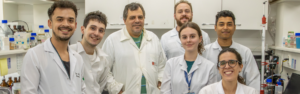

The initiative brought scientific activities and interactive experiences to elementary and middle school students in the eastern part of São Paulo.
On September 29, the #Adote Project and Nova Estação Ciência joined forces to bring a scientific experience to elementary and middle school students in the eastern part of São Paulo. The initiative, titled “#Adote Project and Nova Estação Ciência in São Paulo’s East Zone: A Journey into the World of Microorganisms,” offered a series of interactive activities designed to introduce approximately 350 students to science and the university environment.
Held at Wanny Salgado Rocha Municipal School (EMEF Profa. Wanny Salgado Rocha), the event brought together students from sixth to ninth grade for a program featuring activities on different scientific topics. The aim was to provide students with a dynamic and immersive learning experience, connecting scientific concepts to practical situations and encouraging their interest in universities and the fields of science and biology.
One of the event’s highlights was the participation of Nova Estação Ciência, which joined the activities organized by the #Adote Project. The partnership broadened the range of topics presented to students, bringing together different approaches to science and creating a learning journey spanning subjects such as fossils, bacteria, fungi, viruses, and microbial diversity.
During the visit, students took part in activities adapted to different age groups. One of these was MicroClima, an educational game exploring concepts related to bacterial resistance and microbial ecology. Students also participated in a Nova Estação Ciência activity on fossils, which introduced concepts related to the history of life.

The world of fungi was also part of the program through the #Adote um Fungo project. Students observed previously grown cultures on plates and learned about different aspects of these microorganisms through an interactive, demonstration-based approach.
Another activity focused on the diversity of microorganisms found in the environment. Students collected environmental samples on culture plates and observed previously grown cultures, making visible a microbial diversity that normally cannot be seen with the naked eye.
The #Adote um Vírus project presented a simulation of viral inoculation in embryonated eggs. The activity was used to discuss concepts related to viruses and, in particular, the importance of vaccination in preventing disease.

The initiative aimed to bring students closer to the university environment and spark their interest in higher education, particularly in science and biology. Dynamic, interactive, and immersive activities were used to foster engagement with scientific knowledge.
The joint initiative by the #Adote Project and Nova Estação Ciência highlighted the importance of bringing universities and schools closer together and creating opportunities for students to experience different ways of practicing and engaging with science. By bringing a journey through diverse scientific topics to São Paulo’s East Zone, the event sought to turn learning into an experience of discovery, curiosity, and connection with the university.
Highlights from the event at EMEF Profa. Wanny Salgado Rocha, showing students participating in the different activity stations, interacting with facilitators and teachers, and taking part in hands-on educational experiences throughout their journey into the world of microorganisms.

Event photos:
https://drive.google.com/drive/folders/1HGJg2ugmXuYDcdYmF8L1bRlpE4WUfkky?usp=drive_linkEvent video:
https://www.instagram.com/reel/Dd82fWVxyNt/?utm_source=ig_web_copy_link&stkn=MzRlODBiNWFlZA==
Organization
The activity was organized by the #Adote Project, coordinated by Professor Rita de Cássia Café Ferreira, chair of the Culture and Extension Committee at the Institute of Biomedical Sciences of the University of São Paulo (ICB-USP) and a researcher at the Center for Research in Biology of Bacteria and Bacteriophages (CEPID B3). The event was held in partnership with Nova Estação Ciência, part of USP’s Office of Culture and University Extension (PRCEU), with contributions from the Laboratory of Emerging Virus Research (LPVE) and the Laboratory of Pathogenic Dimorphic Fungi.
The following facilitators also took part in the activity: Ana Luiza Alarcon de Paula, Bruna Rodrigues Corrêa, Carolina Diorio Nastaro, Giovana Tarantini, Nicole Gonçalves Picinin, Pedro Lucas Batalha Marcelino, Miguel Paneczko Bacci, Ana Beatriz da Cruz Gomes, Gustavo de Oliveira Fenner, Luana de Lima Maciel, Thais Pailo de Carvalho, and Gabriel Davi Marena.
Acknowledgments
The organizing team thanks EMEF Profa. Wanny Salgado Rocha for its warm welcome, partnership, and support throughout the event. Special thanks go to the school’s principal, Brígida Ana Carvalho Maia Brito, for her collaboration in organizing the activities, which was essential to the success of the initiative and to strengthening the connection between the university, the school, and society.
Professor Rita de Cássia Café Ferreira — ICB-USP
Ana Luiza Alarcon de Paula
Bruna Rodrigues Corrêa
Carolina Diorio Nastaro
Nicole Gonçalves Picinin
Giovana Tarantini
Pedro Lucas Batalha Marcelino
Professor Suzana Ursi (Director) — Estação Ciência
Miguel Paneczko Bacci
Ana Beatriz da Cruz Gomes
Professor Jansen de Araújo — ICB-USP
Gustavo de Oliveira Fenner
Luana de Lima Maciel
Thais Pailo de Carvalho
Postdoctoral researcher Gabriel Davi Marena — ICB-USP
Authors: Bruna Rodrigues Corrêa and Rita de Cássia Café Ferreira