
Leia mais sobre o artigo Monomeric Esterase: Insights into Cooperative Behavior, Hysteresis/Allokairy
Monomeric Esterase: Insights into Cooperative Behavior, Hysteresis/Allokairy

Monomeric Esterase: Insights into Cooperative Behavior, Hysteresis/Allokairy

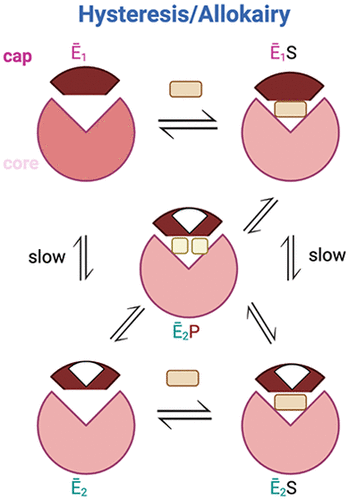
Herein, we present a novel esterase enzyme, Ade1, isolated from a metagenomic library of Amazonian dark earths soils, demonstrating its broad substrate promiscuity by hydrolyzing ester bonds linked to aliphatic…
Continue lendoMonomeric Esterase: Insights into Cooperative Behavior, Hysteresis/Allokairy

The structural and functional basis of GenB2 isomerase activity from gentamicin biosynthesis

Aminoglycosides are important antibiotics used to treat severe infections caused mainly by gram-negative bacteria. Gentamicin is an aminoglycoside, and despite its toxicity, is clinically used to treat several pulmonary and…

Continue lendoThe structural and functional basis of GenB2 isomerase activity from gentamicin biosynthesis
Leia mais sobre o artigo Integration of biophysical and biological approaches to validate fragment-like compounds targeting l,d-transpeptidases from Mycobacterium tuberculosis
Integration of biophysical and biological approaches to validate fragment-like compounds targeting l,d-transpeptidases from Mycobacterium tuberculosis

Integration of biophysical and biological approaches to validate fragment-like compounds targeting l,d-transpeptidases from Mycobacterium tuberculosis

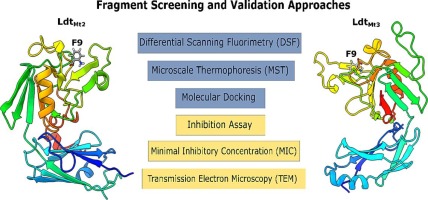
Fragment-based approaches validate weak-affinity compounds targeting LdtMt2 and LdtMt3 from Mycobacterium tuberculosis. Some fragments inhibit the nitrocefin hydrolysis by by LdtMt2 and LdtMt3. F9 inhibits the growth of Mycobacterium smegmatis and induces morphological alterations in vitro. Combination of biophysical and…

Continue lendoIntegration of biophysical and biological approaches to validate fragment-like compounds targeting l,d-transpeptidases from Mycobacterium tuberculosis
Leia mais sobre o artigo A quorum-sensing regulatory cascade for siderophore-mediated iron homeostasis in Chromobacterium violaceum
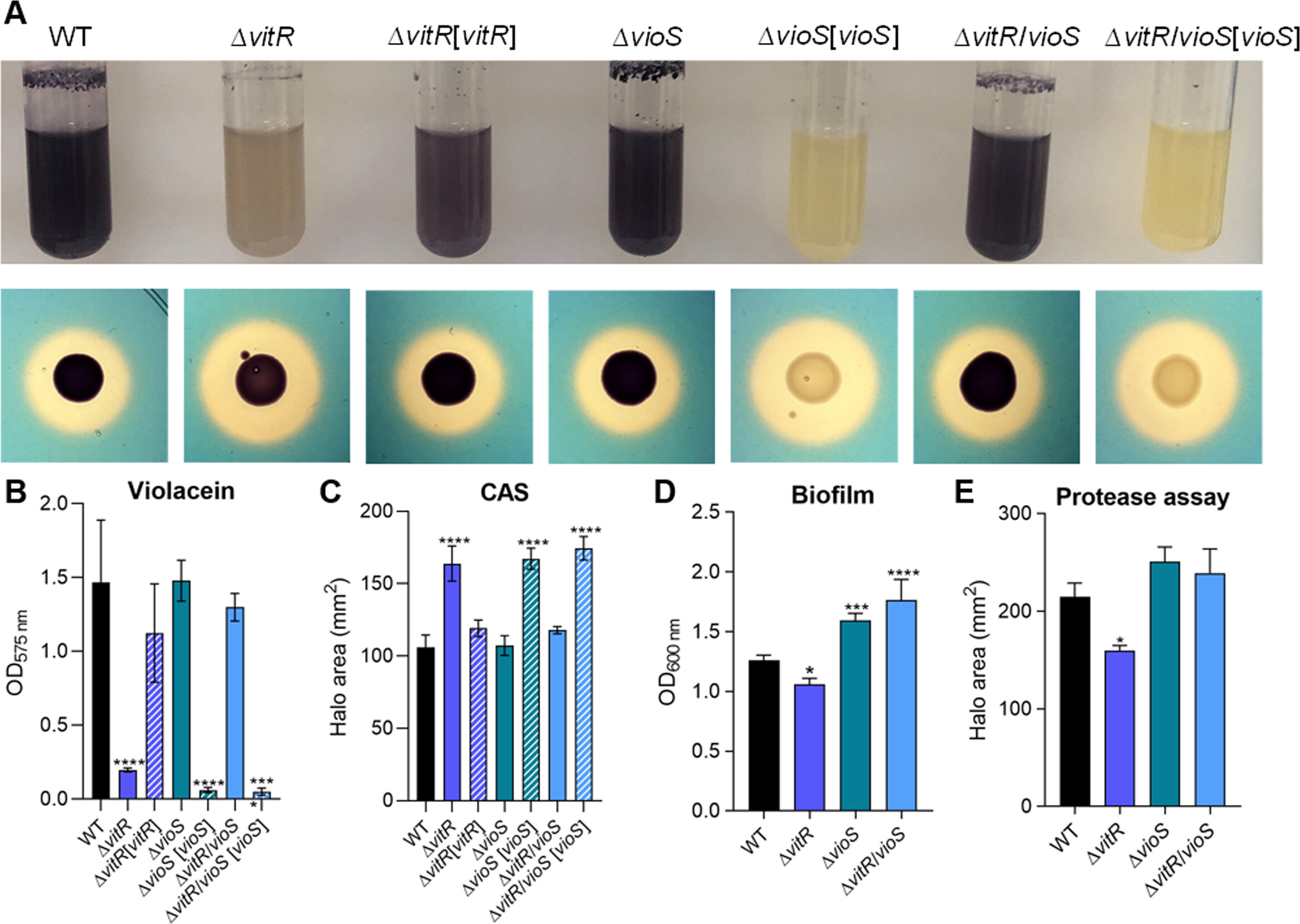
Phenotypic characterization of the ∆vioS and ∆vitR/vioS mutants. (A) Growth of the indicated strains in LB medium to verify the production of violacein and CAS tests showing the production of siderophores (orange halos) by the indicated strains inoculated on PSA-CAS plates. (B) Quantification of violacein production of the indicated strains. The strains were grown in LB medium under agitation at 37°C for 24 h. After incubation, 500 µL of culture was homogenized with 500 µL of acetone. After centrifugation, OD575 was measured for quantification of violacein. Data from three biological assays. ****P < 0.0001; when not indicated, not significant (n.s.). One-way ANOVA followed by Tukey’s multiple-comparison test. (C) Measurement of the CAS halo areas of the indicated strains. Data from three biological assays. Statistical analyses using one-way ANOVA followed by Dunnett’s multiple comparisons test. ****P < 0.0001, when not indicated, n.s. (D) Biofilm assay of the indicated strains. The strains were grown in LB medium for 24 h and the assay was performed with crystal violet to quantify biofilm. Data from six biological assays. Statistical analyses using one-way ANOVA followed by Dunnett’s multiple comparisons test. *P < 0.05; ***P < 0.001; ****P < 0.0001; when not indicated, n.s. (E) Protease tests showing the production and secretion of proteases in M9 plates supplemented with 1.5% of powdered milk. Measurement of the protease halo areas of the indicated strains. Data from three biological assays. Statistical analyses using one-way ANOVA followed by Dunnett’s multiple comparisons test. *P < 0.05; when not indicated, n.s.

A quorum-sensing regulatory cascade for siderophore-mediated iron homeostasis in Chromobacterium violaceum

Iron is a transition metal used as a cofactor in many biochemical reactions. In bacteria, iron homeostasis involves Fur-mediated de-repression of iron uptake systems, such as the iron-chelating compounds siderophores.…

Continue lendoA quorum-sensing regulatory cascade for siderophore-mediated iron homeostasis in Chromobacterium violaceum

Xanthomonas immunity proteins protect against the cis-toxic effects of their cognate T4SS effectors

  • Autor do post:
  • Categoria do post:Artigos

Abstract Many bacteria kill rival species by translocating toxic effectors into target cells. Effectors are often encoded along with cognate immunity proteins that could (i) protect against “friendly-fire” (trans-intoxication) from…

Continue lendoXanthomonas immunity proteins protect against the cis-toxic effects of their cognate T4SS effectors