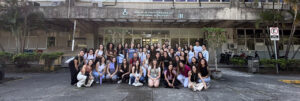
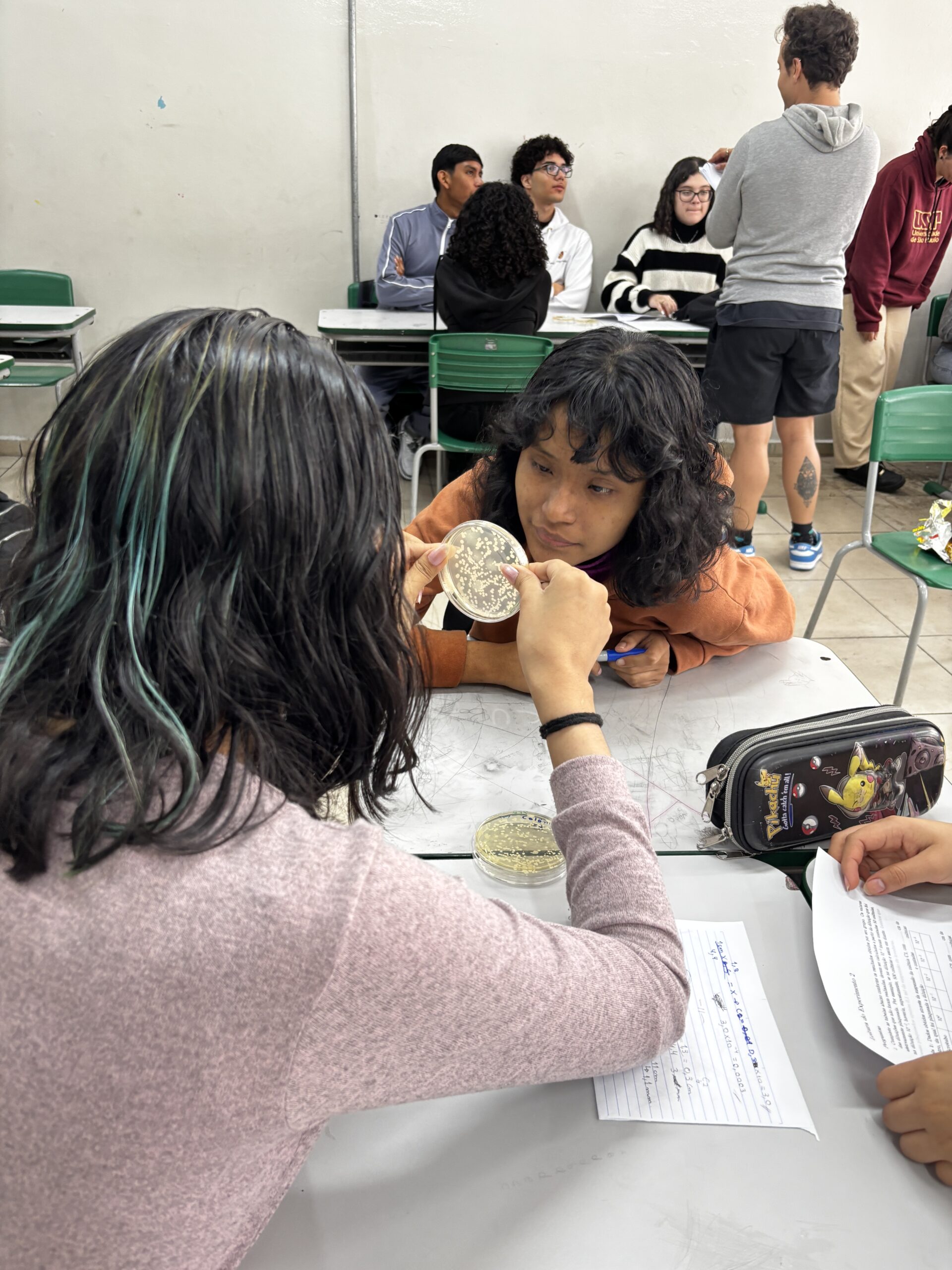
Second-year students at the Professor Fidelino de Figueiredo State School in São Paulo are diving into the worlds of microbiology and mathematics through Micromat — a free initiative created by students and professors at the University of São Paulo (USP). Throughout the activities, students are introduced to a variety of scientific concepts, such as microorganism cultivation, scientific notation, and pipetting, and they have the opportunity to connect real situations from scientific practice with theoretical content learned in class, including multiplication, scale, and mathematical functions.
The Micromat program consists of three hands-on experiments that allow students to get involved and step into the role of young scientists. The trio of tests is carried out using yeast — microscopic fungi found in baker’s yeast and widely used in the production of bread, beer, and other foods. “It’s something everyday and risk-free that can be very useful for learning,” explains Carolina Peixoto, one of the project’s creators and facilitators.
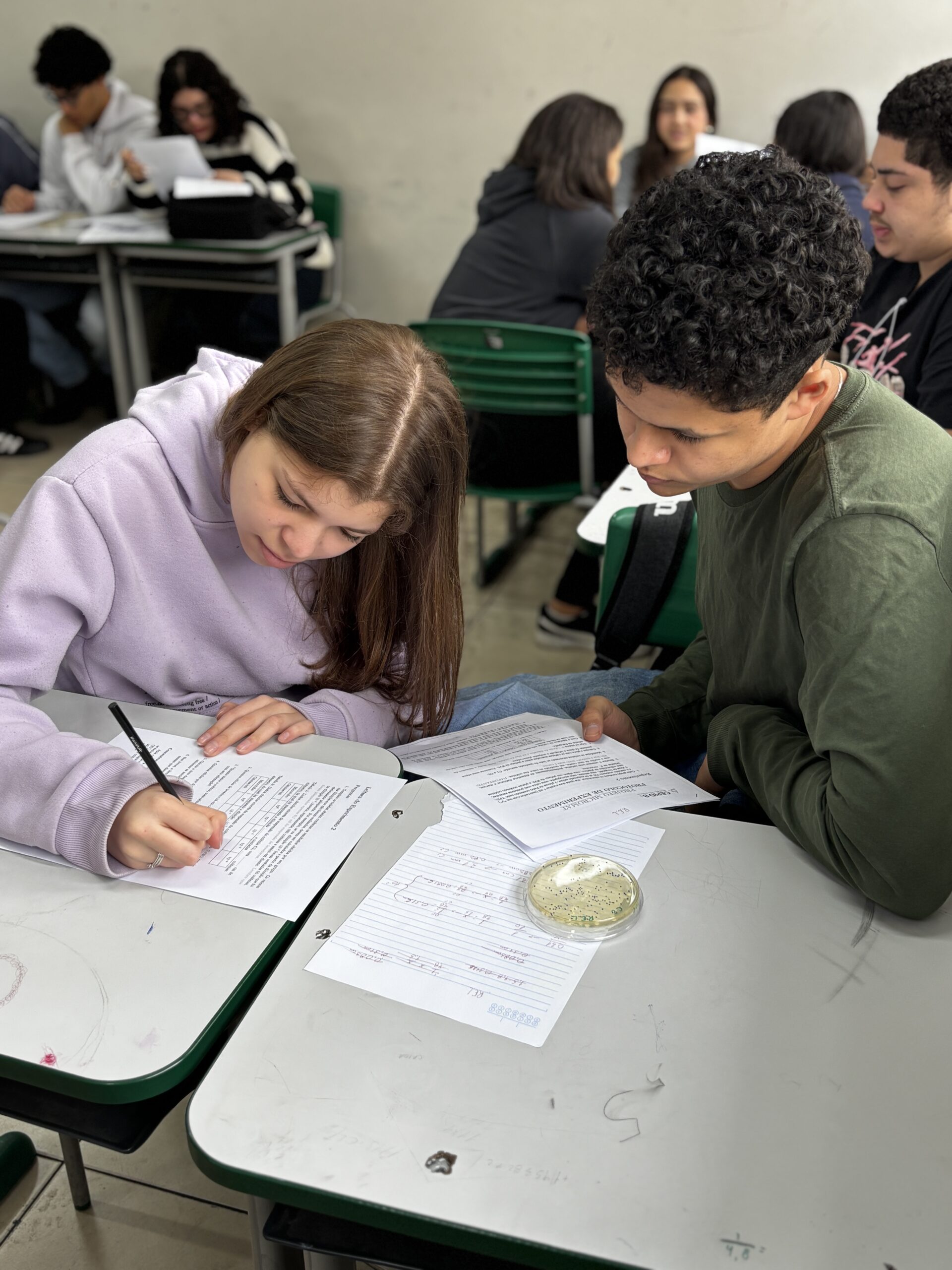
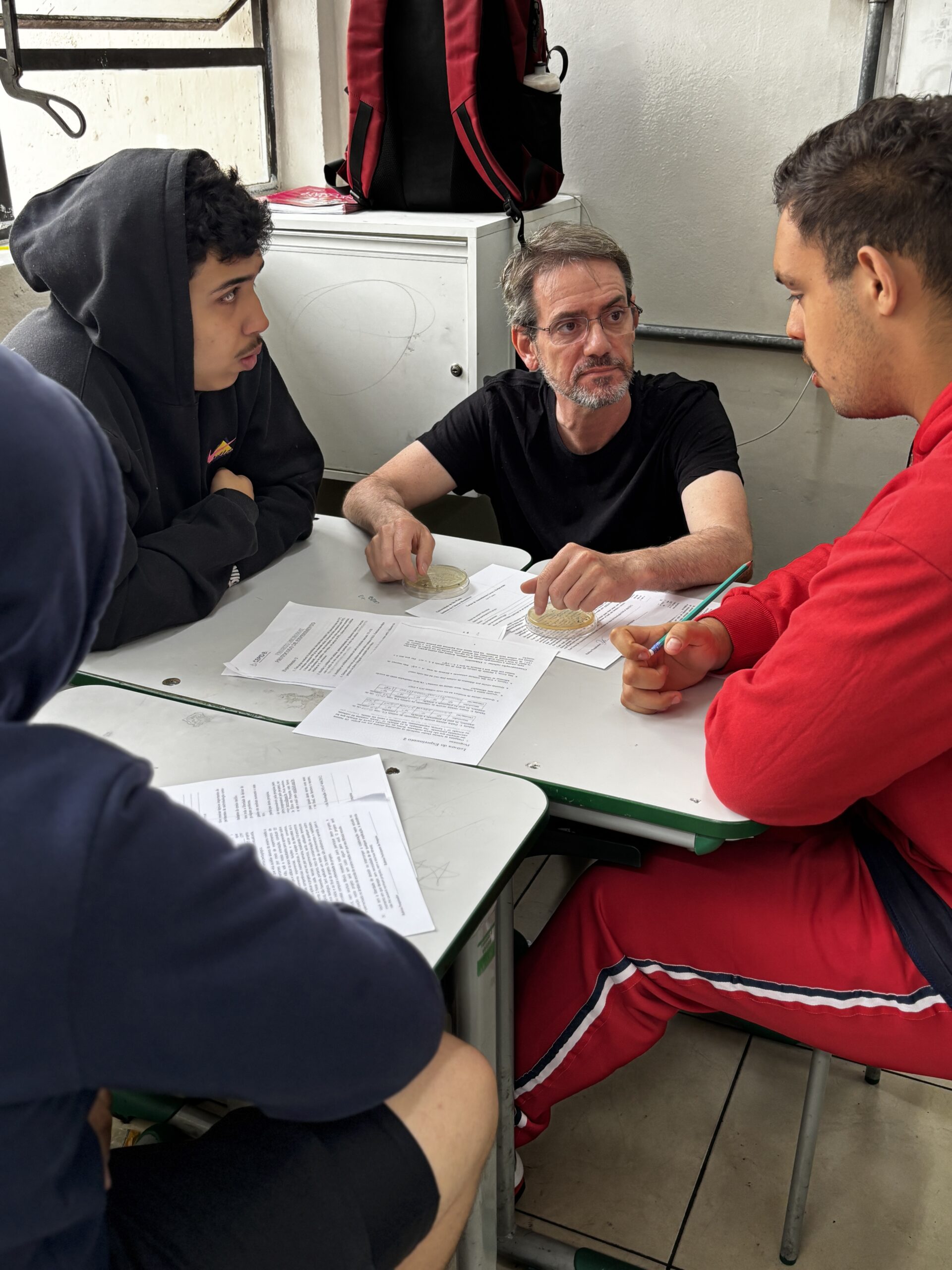
Over the course of roughly eight lessons, students follow the growth of these microorganisms on culture plates and perform steps such as diluting yeast in different tubes, counting and measuring the colonies formed, and interpreting results through the production and analysis of graphs. The entire process is guided by questions that stimulate reasoning and critical thinking based on three central issues: “How many yeast cells are in 1 gram of baker’s yeast?”, “How many cells are in a yeast colony?”, and “How can we measure and calculate the rate of cell growth?” To reach the desired results, students also apply a range of mathematical operations, such as logarithms, unit conversions, and exponentiation. “You learn math by doing,” Peixoto emphasizes.
According to the facilitator, one of Micromat’s major strengths is the combination of hands-on experiences with the encouragement of independence. “At school, we often work with ready-made, tidy problems. In this project, you’re placed in the real world — you’re the one who has to set the scale, draw the graphs…,” she says. “We need to teach how to do things, not just hand everything over,” she adds, stressing that the goal is to make it easier to assimilate concepts already taught in class and included in the Brazilian National Common Core Curriculum (BNCC). The interdisciplinary connection between microbiology and mathematics is also a hallmark of the project — and it is precisely this bridge that, according to the organizers, helps spark students’ curiosity and confidence.
The project is led by researcher Beny Spira from USP’s Institute of Biomedical Sciences (ICB) and is part of the Center for Research on Bacteria and Bacteriophages (CEPID B3/USP). By early this year, it had already undergone preliminary implementation in two second-year classes at different public schools. It is now moving forward with its schedule in the second class of the Professor Fidelino de Figueiredo State School, located in downtown São Paulo. According to the coordinator, the aim is to continue implementing the project in other classes at the same school and, in the future, expand its reach to new groups.
Bring the Micromat project to your school!
Teachers, principals, coordinators, and other administrators responsible for second- or third-year high school classes (regular or EJA) in São Paulo or nearby cities can request more information or apply by emailing the project coordinator at benys@usp.br. You can also learn more about the experiments and lesson content on Micromat’s official website.
Learn more
Follow the Micromat project on Instagram: @micromat3
Learn more about this and other initiatives on CEPID B3’s social media (@cepidb3) and on the Center’s official website.

![Leia mais sobre o artigo [en] Alunas do CEPID B3 levam 3 prêmios na 54ª Reunião Anual da SBBq](https://cepidb3.iq.usp.br/wp-content/uploads/sites/1346/2024/06/B-300x169.jpg)