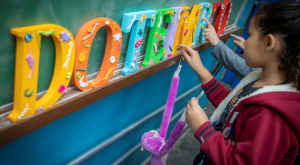

From the laboratory to Estação Ciência, students took part in an immersive journey into the world of microorganisms.
On October 1, the #Adote Project and Estação Ciência organized an immersive science education and outreach experience for 48 third-year high school students at the Institute of Biomedical Sciences (ICB) of the University of São Paulo (USP) and Nova Estação Ciência. The activity brought young people closer to the University’s research and teaching facilities and provided them with direct exposure to different areas of microbiology.
The program began at ICB-USP with opening remarks by Professor Rita de Cássia Café Ferreira. Throughout the morning, participants took part in activities related to viruses, bacteria, and protozoa, held in different laboratories and facilities within the Department of Microbiology.
The activities were specifically designed for high school students who had previously participated in the Adote um Microrganismo initiative, aiming to connect scientific concepts with practical, interactive experiences. Activities included exploring bacterial diversity and the importance of handwashing, presentations on the role of protozoa in health, and an immersive activity focused on viruses.

After the activities at ICB, the students headed to Estação Ciência, where they took part in a program focused on scientific exploration and discovery. One of the activities involved fossils, broadening the experience beyond microbiology and allowing participants to explore different ways of engaging with science.

Beyond introducing scientific concepts, the initiative aimed to bring students closer to the university environment. By visiting laboratories, meeting researchers and undergraduate and graduate students, and exploring different science outreach spaces, participants experienced science beyond the classroom.

Event photos:
https://drive.google.com/drive/folders/1MjDuDw1YkktMOF03ku9m6uGMVLNVwltZ?usp=drive_link
Organization
The activity was organized by the #Adote Project, coordinated by Professor Rita de Cássia Café Ferreira, chair of the Culture and Extension Committee at ICB-USP and a researcher at the Center for Research in Biology of Bacteria and Bacteriophages (CEPID B3). The event was held in partnership with Nova Estação Ciência, part of USP’s Office of Culture and University Extension (PRCEU), with the participation of the Laboratory of Emerging Virus Research (LPVE) and the Laboratory of Leishmania Cellular Immunobiology.
The following facilitators also took part in the activity: Bruna Rodrigues Corrêa, Carolina Diorio Nastaro, Giovana Tarantini, Nicole Gonçalves Picinin, Pedro Lucas Batalha Marcelino, Gustavo de Oliveira Fenner, Thais de Pailo, and Osayanne Fernandes Martins Lopes.
Acknowledgments
The organizing team thanks the Federal Institute of São Paulo (IFSP), Sorocaba campus, for its warm welcome, partnership, and support throughout the event. Special thanks go to Professor Alexandre La Luna for his collaboration in organizing the activities, which was essential to the success of the initiative and to strengthening the connection between the university, schools, and society.
Rita de Cássia Café Ferreira — ICB-USP
Bruna Rodrigues Corrêa
Carolina Diorio Nastaro
Nicole Gonçalves Picinin
Giovana Tarantini
Pedro Lucas Batalha Marcelino
Suzana Ursi (Director) — Estação Ciência
Patrícia Mourad
Miguel Paneczko Bacci
Beatriz de Menezes Santos
Ricardo de Ávila Mesquita
Jansen de Araújo — ICB-USP
Gustavo de Oliveira Fenner
Thais de Pailo
Mauro Javier Cortez Véliz — ICB-USP
Osayanne Fernandes Martins Lopes
Authors: Bruna Rodrigues Corrêa and Rita de Cássia Café Ferreira