Activity organized by the #Adote Project brought high school students closer to scientific research, science communication and everyday university life
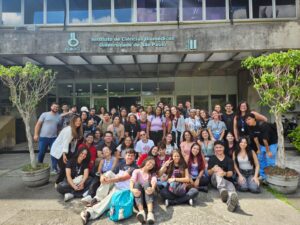
Twenty-five high school students from the Federal Institute of São Paulo (IFSP) took part in an immersive experience in the world of microorganisms during the event “Journey into the World of Microorganisms at Nova Estação Ciência,” organized by Estação Ciência and the #Adote Project, from the Department of Microbiology at the Institute of Biomedical Sciences (ICB) of the University of São Paulo (USP). The program included hands-on activities at ICB and a visit to the Nova Estação Ciência facility, giving students different opportunities to engage with science and experience University spaces.

With the aim of expanding and deepening the knowledge developed throughout their participation in the #Adote Project, the students explored topics related to viruses, bacteria, fungi and archaea through hands-on activities, presentations and interactive exercises.
In the morning, the students were welcomed at the Department of Microbiology at ICB-USP. The activities allowed them to explore different aspects of microbial diversity and understand the importance of these organisms to health, the environment and society.
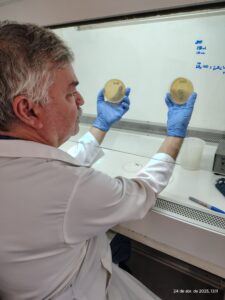
The program also included activities with the Pathogenic Dimorphic Fungi Laboratory and the Emerging Viruses Laboratory, giving students the opportunity to learn about different areas of research conducted at the University and to interact with researchers and environments dedicated to scientific knowledge production.

In addition to the academic activities, the students had the opportunity to learn more about everyday university life. Lunch at the USP Central Dining Hall (“Bandejão Central”) was part of the program, providing participants with an experience that is part of the daily routine of many University students and contributing to a broader introduction to the university environment.

In the afternoon, the group headed to Nova Estação Ciência, a USP science communication space dedicated to bringing science and society closer together. There, the students took part in hands-on and interactive activities focused on archaea and learned about initiatives developed by Estação Ciência.
The visit also allowed participants to learn about aspects of the heritage, history and environment of USP’s Butantã campus. Along the way, students observed elements of the campus’s fauna and flora, learned about historical landmarks of the University and visited one of its best-known symbols: the Clock of Praça do Relógio.

Throughout the program, students were encouraged to take an active role in the activities by formulating hypotheses, making observations and connecting the topics presented with the knowledge they had developed through their participation in the #Adote Project. The initiative sought to emphasize experiential learning and foster students’ interest in science and scientific inquiry.
The initiative is part of the #Adote Project’s science education and communication activities and highlights the importance of strengthening connections between public universities and basic education. By enabling high school students to explore spaces dedicated to teaching, research, outreach and science communication, the activity expands opportunities for dialogue between USP and schools and helps present the University as a space for producing and sharing knowledge.
More than a visit to USP facilities, “Journey into the World of Microorganisms at Nova Estação Ciência” provided students with an opportunity to engage directly with different dimensions of university life and science. The activity highlights the University’s role in scientific education and in creating spaces for dialogue with society, bringing the knowledge produced at USP closer to new audiences.
See some highlights from the event in this video:
https://www.instagram.com/reel/DcuWophx9xP/?utm_source=ig_web_copy_link&igsi=MzRlODBiNWFlZA==